
Giving Back: Restoring Smiles, Building Fulfillment
Olympic Peninsula Community Clinic meets community oral health needs, provides dentists with rewarding moments
Quick Bites:
- Olympic Peninsula Community Clinic provides free medical, dental, and behavioral health services to people in Clallam and Jefferson counties.
- The clinic first began providing medical services in a Port Angeles church basement in 2001. Dental services were gradually added, but the clinic lacked dedicated space for oral health care.
- In 2014, it moved to its current location in Port Angeles, which includes five medical exam rooms and five dental operatories.
- COVID-19 forced the closure of the OPCC dental clinic. It fully reopened in 2024 and has steadily seen an increase in patients returning for hygiene care and other dental services.
- OPCC dental clinic has just one paid employee — the clinic manager — and relies on volunteer dentists, hygienists and dental assistants to provide services to patients, regardless of their insurance coverage or ability to pay.
Annette Pearson, a private practice dentist in Wilsonville, Oregon, is looking forward to retirement and her new home in Port Angeles.
As luck would have it, the volunteers and patients of the Olympic Peninsula Community Clinic are looking forward to her relocation, too.
After 15 years of operating Affordable Dentures & Implants, she’s put her business up for sale with plans on moving to the Olympic Peninsula. Oregon may be in the rearview mirror, but she’s not ready to leave dentistry behind.
“I wanted to do something for the community, so I went to the clinic. I didn’t know what to expect,” she said “I’ve worked at other free clinics in Indiana — they were pretty bare bones. Lots of old equipment, things like that. But I was totally amazed at how new and clean and up to date [OPCC] was. The staff are amazing and the facility is very nice. It’s well supplied, it’s clean.”
In January, Pearson shadowed another local dentist — WSDA member Dr. Todd Haworth of Ridgeline Dental in Port Angeles — at OPCC, getting to know the patients and staff at the clinic.
“When I got there to shadow Dr. Haworth, the clinic totally blew me away,” said Pearson, who has now volunteered for three months at OPCC.
“I will look for something more part-time once my practice in Wilsonville is sold. But this gives me a way to get up there and get familiar with the community. Now I go once a month, and each time, I’ve gotten more out of it than I gave. It did more for me than I could’ve ever possibly given of myself.”
Meeting Community Needs
For OPCC CEO Scott Brandon, the “light bulb” moment came when he and the clinic’s medical director realized patients aren’t always found in the waiting room.
Many are unhoused, living outdoors with limited access to shelter, let alone medical and dental care, said Brandon. Others are seniors living on fixed incomes with limited resources or access to care.
“What we’ve found over the years is that traditional mental, dental and medical care doesn’t serve this segment of the population well — especially those who live outdoors or are unfamiliar with the system or how to navigate it on their own,” said Brandon. “The biggest shift we made as an organization was taking the care to the patients. We started looking for patients rather than waiting for them,” he said. “Our mission on paper stayed the same, but the actions behind it changed. When we did that, we found even more unmet needs in our community.”
OPCC got its start in 2001 as the Port Angeles Association of Religious Community or PAARC Clinic, seeing patients one evening a week in a Port Angeles church basement. There wasn’t even room for a dental chair or equipment, Brandon recalls. Area dentists provided supplies and equipment, including a handheld X-ray unit, which was makeshift but got the job done. Two mobile chairs were also donated, allowing the clinic to take its services out to people in and around Clallam and Jefferson counties.
“One of the greatest things about our volunteers is that they come into our clinic and see something that’s useful in their own clinics and say, ‘You should have this,’” said Brandon. That’s how we got the handheld X-ray and so many other things.”
"When they can get their teeth fixed, it allows them to get their smile back and helps them in their own growth and development until ultimately, they don't need us anymore."
By 2005, the clinic became known as Volunteers in Medicine. As word of the clinic spread, demand for services also grew. The clinic again sought a bigger space to accommodate more patients. In 2014, it moved to its current location in Port Angeles, which includes five medical exam rooms and space for five dental operatories.
Finding appropriate space for a dental clinic was one thing — supplying it with the right equipment was another. In addition to volunteer donations from the local dental community, the clinic sought grants from the Washington State Department of Commerce, Washington Dental Service Foundation (WDSF, now Arcora), and private foundations. These grants allowed clinic staff to replace donated chairs and create a more modern dental facility with newer equipment and increased treatment capacity.
In 2018, the clinic was renamed Olympic Peninsula Community Clinic, which better reflected the range of services provided.
Then came the pandemic.
Like many volunteer operations, OPCC was forced to close its doors during the pandemic. Its volunteer dentists couldn’t come to the clinic but would see patients at their own practice.
In 2024 — four years after the pandemic started — OPCC resumed their full suite of in-clinic dental services. In 2025, the clinic’s 14 volunteer dentists served 102 patients in clinic, and another 482 people through mobile clinics or direct outreach in the community.
“A lot of our clientele in underserved populations have some of the most severe problems with their teeth, and that affects their social and medical aspects,” said Brandon. “When they can get their teeth fixed, it allows them to get their smile back and helps them in their own growth and development until ultimately, they don’t need us anymore.”
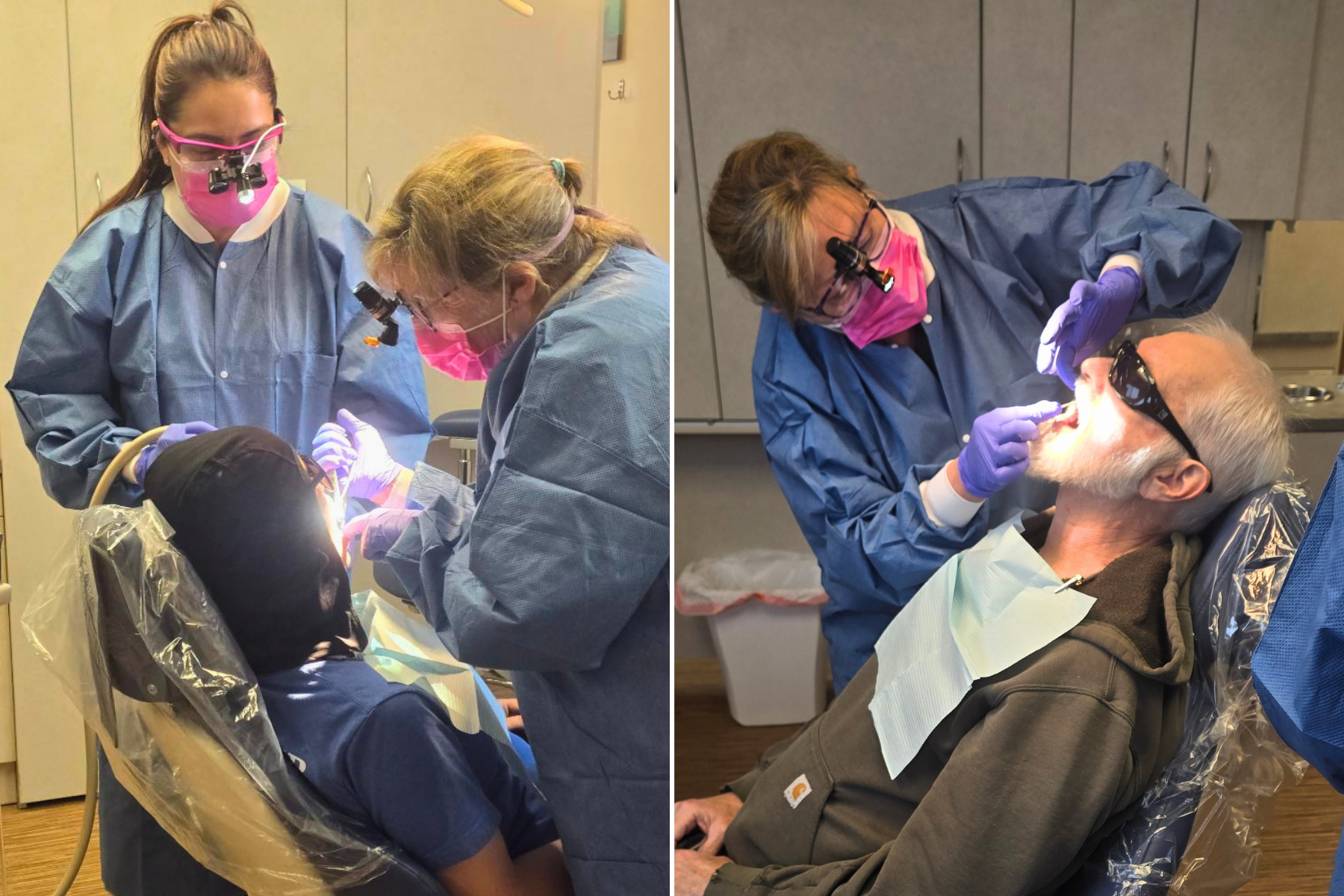
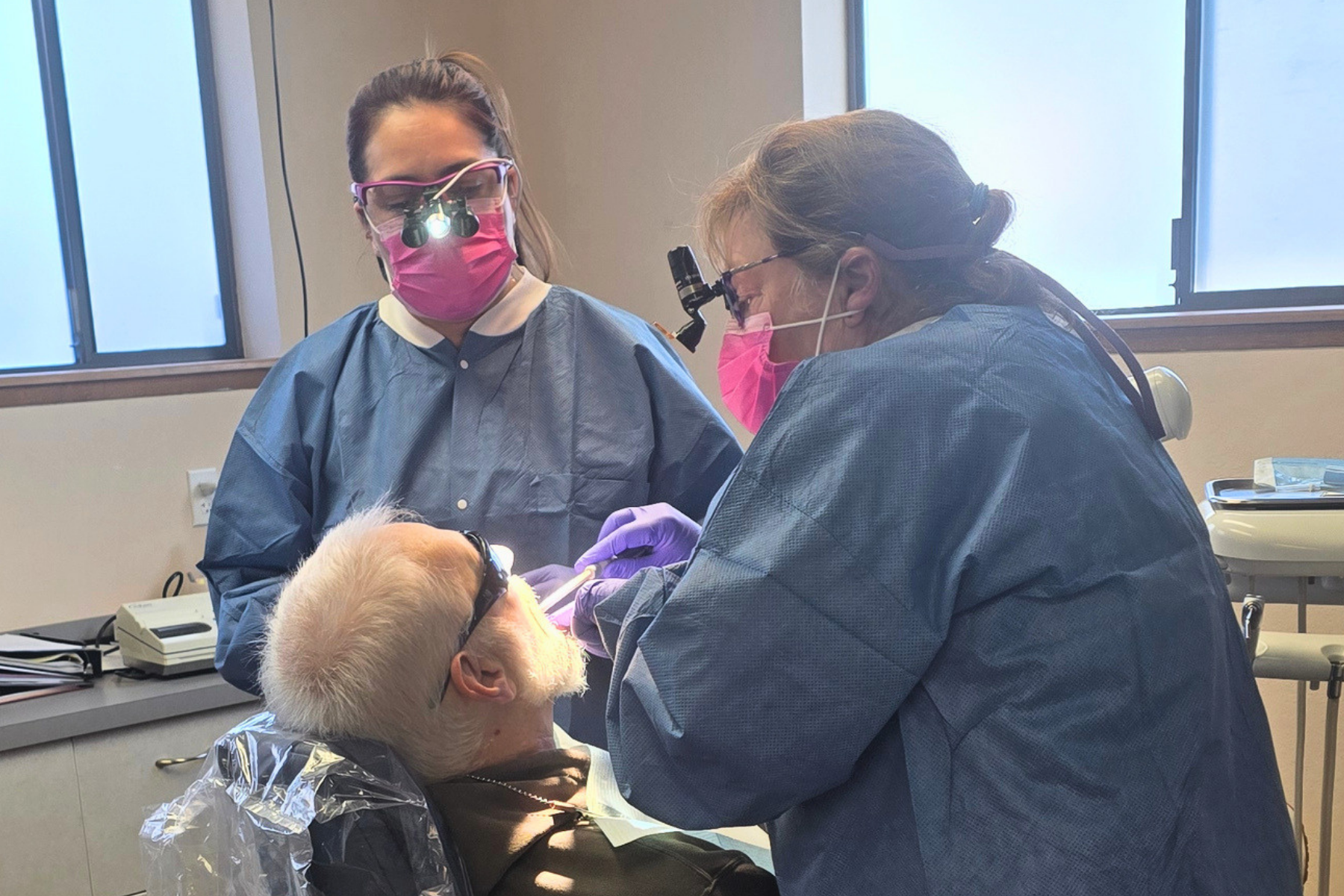
Dr. Annette Pearson (R) and Dental Assistant Martha Delgado (L) perform an exam on a patient at OPCC.
A Volunteer Network
Martha Delgado works full-time in Dr. Todd Haworth’s dental practice, as his dental assistant. On Friday, she volunteers with Haworth and Pearson at the clinic. She’s just completed her pre-requisites for hygiene school at the recently accredited Peninsula College.
Together, she and dental clinic manager Kayla La Fritz work closely to keep things running smoothly and well-supplied.
“There is a huge need in this community,” said Delgado. “Patients are often in desperate need of an extraction — just getting that tooth out can help them feel better,” she said. “It is so rewarding to help patients get out of pain or really wanting to smile again.”
The individual practice strengths of the volunteer doctors complement the needs of OPCC patients: Pearson performs extractions while Haworth focuses on restorative work.
Haworth, who has volunteered with the clinic in its various forms over the years, is also on the verge of retirement. Like Pearson, he plans to stay engaged with OPCC as part of his retirement plans.
“I’ve spent a lot of time and energy running a dental practice and there are a million other things to pay attention to. Volunteering is certainly less stressful than running a practice,” said Haworth. “Fortunately, the staff takes care of all the administrative details, and we just get to focus on fixing teeth. The clinic has done a good job of helping us be efficient in our giving. We get a lot done in a short period of time.”
“We say that we are the ‘fun’ side of medicine,” said La Fritz. “We are not worried about billing — the patient load, charting and billing requirements are much different here. We aren’t tied to appointment times — the providers can spend as much time as they need with the patients.”
Both Haworth and Pearson agree that La Fritz’s energy and enthusiasm is part of what keeps the clinic operating so smoothly.
"There is a huge need in this community. Patients are often in desperate need of an extraction —just getting that tooth out can help them feel better. It is so rewarding to help patients get out of pain or really wanting to smile again.
“She is the pivotal part of making this work,” added Peearson. “Her energy is amazing.”
Finding more Dr. Haworths and Dr. Pearsons is also a challenge for clinics like OPCC, which have plenty of chairs but not enough dentists to use them all.
“It’s been nice to have a seasoned assistant like Martha, and I am just blown away that more people don’t volunteer there,” said Pearson. “Even if one person volunteered there once a month — that place would be hopping!”
Haworth added, “We all do voluntary dentistry in our clinics — the amount you do is the amount you do. Outreach like this is for the good of the patients and the good of the profession.”
Brandon says it’s the connections between the volunteer dentists and patients that reaffirm his work with OPCC, and why their volunteers stay so engaged.
“In many cases, the volunteers get just as much out of it as the patients. We work with a lot of volunteer providers who have retired but aren’t ready to be ‘done.’ This is a continuation of their life’s work, and it brings them tremendous satisfaction,” said Brandon, echoing Pearson’s observation.
“Changing people’s lives gives them a sense of fulfillment.”
To learn more about the clinic or to donate, visit opcclinic.org.
If you would like to volunteer at OPCC, start by downloading the volunteer packet here.
This article originally appeared in Issue 2, 2026 of the WSDA News.
