
2026 WSDA Citizen of the Year: Dr. Randall Thompson
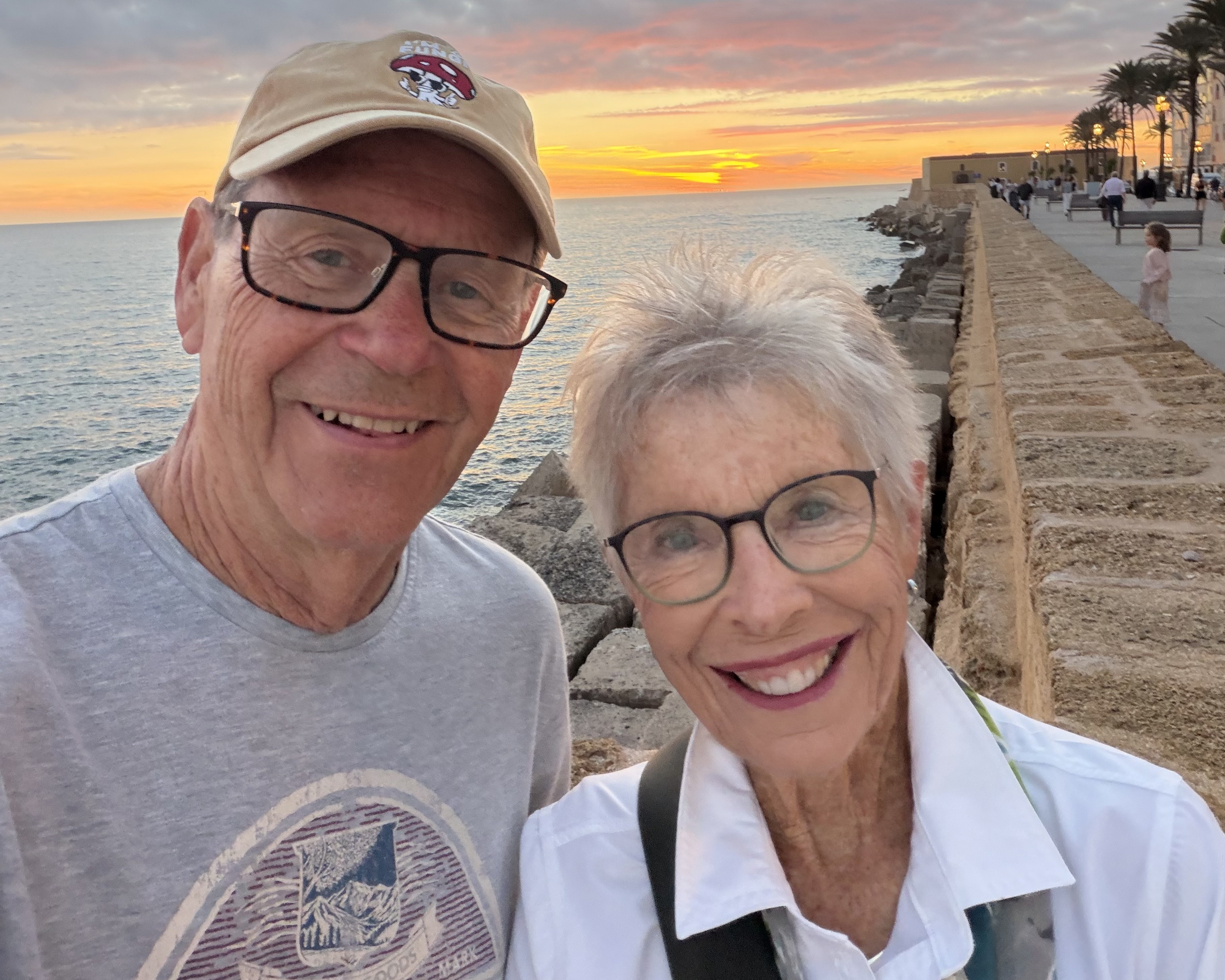
A Part of My Life and Purpose: Watch a short video profile of 2026 Citizen of the Year Dr. Randall Thompson.
Quick Bites:
- Dr. Randall Thompson graduated from UW School of Dentistry and served as an army dentist for 22 years.
- After leaving the military, he was in private practice on Camano Island in Northwest Washington.
- He has been an active volunteer with local organizations such as the Safe Harbor Free Clinic in Stanwood.
- Thompson and his wife of 57 years, Jamie, have taken 40 mission trips to Zambia, Mali, Ethiopia, Tanzania, Papua New Guinea, Haiti, Chile, Mexico, the Dominican Republic, Turkey, and Moldova.
What do a Zambian prison, an Ecuadoran livestock field and a Tanzanian dance club have in common? They’re all places where Dr. Randall “Randy” Thompson, WSDA’s Citizen of the Year, has treated patients during his many mission trips.
But those three unusual venues are just the tip of the iceberg in a volunteer history that has taken Thompson to not only those far-flung countries, but also to the Dominican Republic, Mexico, Chile, Mali, Moldova, Ethiopia, Turkey and Papua New Guinea. He’s traveled to Haiti for 17 years and taken 12 trips to Albania.
He has delivered patient care in a bedroom because it was the only clean space available, in a kitchen while a family sat nearby drinking tea, and in a courtyard because the smell of harsh disinfectants in the nearby building was overpowering. He has traveled to remote islands via a boat ministry, dealt with a dock strike that held up his equipment, and been forced to adjust plans due to natural disasters like earthquakes and flooding.
It’s no wonder that, when asked what the number one attribute of a successful volunteer is, he answered, “You really need to be flexible. What you expect is not what’s going to happen, and you’ve got to be able to adapt.”
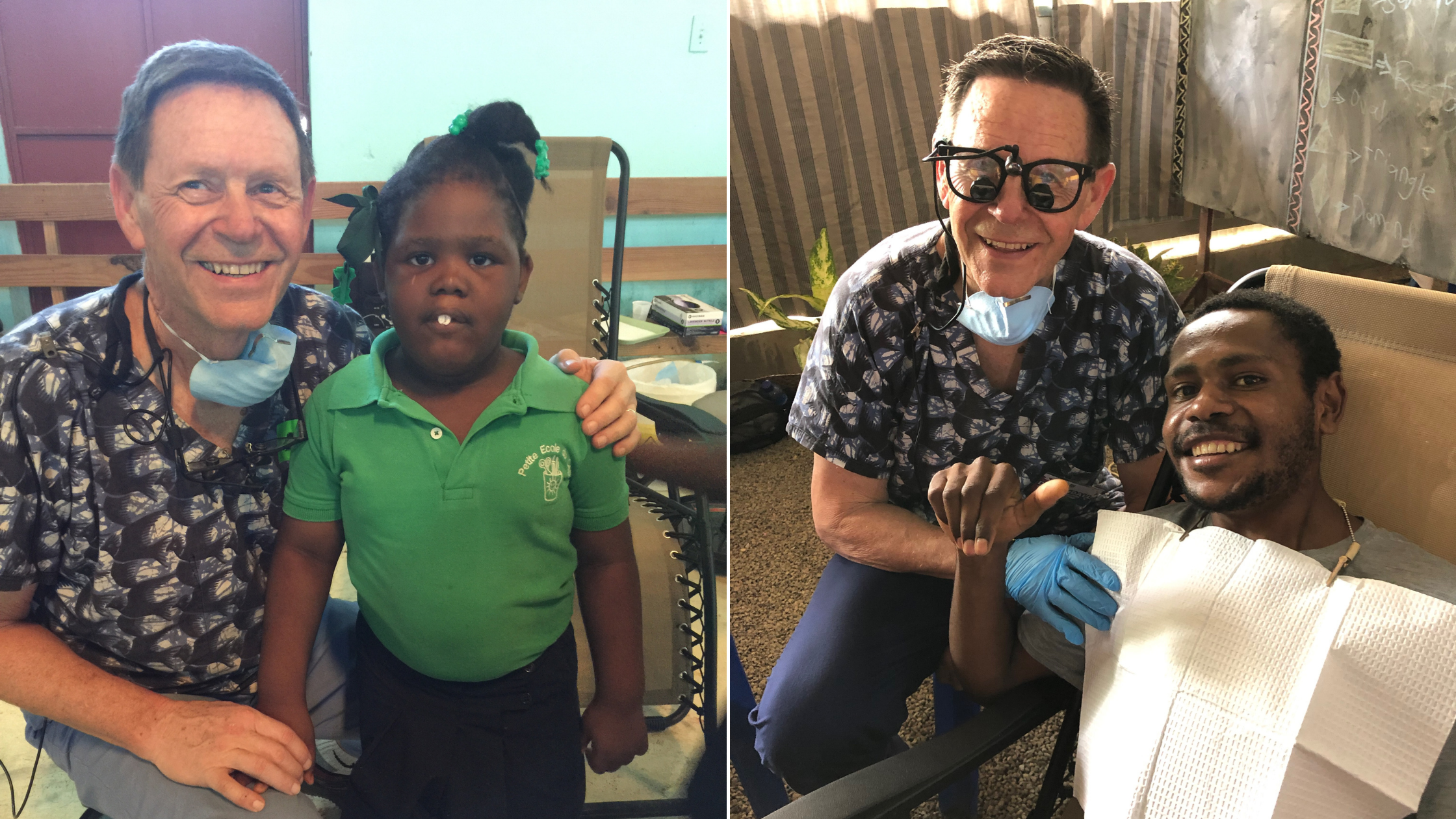
Left: A brave young patient in Haiti. Right: The smile says it all in Mali.
A Great Team
Thompson’s second key attribute for a successful mission trip volunteer is “to be a good team player,” and he’s been blessed with one of the best teammates imaginable.
Of the more than 40 mission trips that he has taken, virtually all have been with his wife Jamie, his high school sweetheart to whom he’s been married for 57 years, at his side. Jamie, a teacher by training, has become Randy’s de facto surgical assistant on these trips.
In what could be an indicator of the strength of their relationship, they have different perspectives on her transition into her assistant role.
“I may have been a little rough on her as I was teaching her to be an assistant,” Thompson recalled. But she remembers her husband’s tutelage differently. “He did very well teaching me; he was very patient,” she said. “It was a whole new area where I kind of got to enter his world, and I loved that.”
Jamie Thompson’s background in education has also proven invaluable in another of her husband’s volunteer endeavors overseas, teaching English to college students in Albania. Randy was hesitant when his Albanian contacts asked him to consider taking on that role, but Jamie encouraged him.
“You can do this,” she told him, and then chipped in to help ensure that her confidence was not misplaced.
“We were working on it together,” she said. “We were putting together lesson plans until midnight every night, after classes every day. It was hard. But it worked.”
Following that initial trip to Albania, Thompson was asked to return and teach at the dental school. He has annually joined a group of healthcare professionals from the US to teach and provide hands-on seminars at a student conference.
Now, after so many trips together, and the untold hours of treatments and teaching together, the couple is completely aligned on one fact – volunteering is best experienced together.
“It’s part of the joy of being able to experience these things together, versus me going and then trying to relate what happened,” Randy said.
Jamie had taken one solo mission trip working with orphans in Romania before the couple began their joint volunteer efforts.
“I came back and tried to explain what the trip was like,” she recalled. “And I said that I can’t do these myself. We have to do it together, because you can never express to each other how much it really means.”
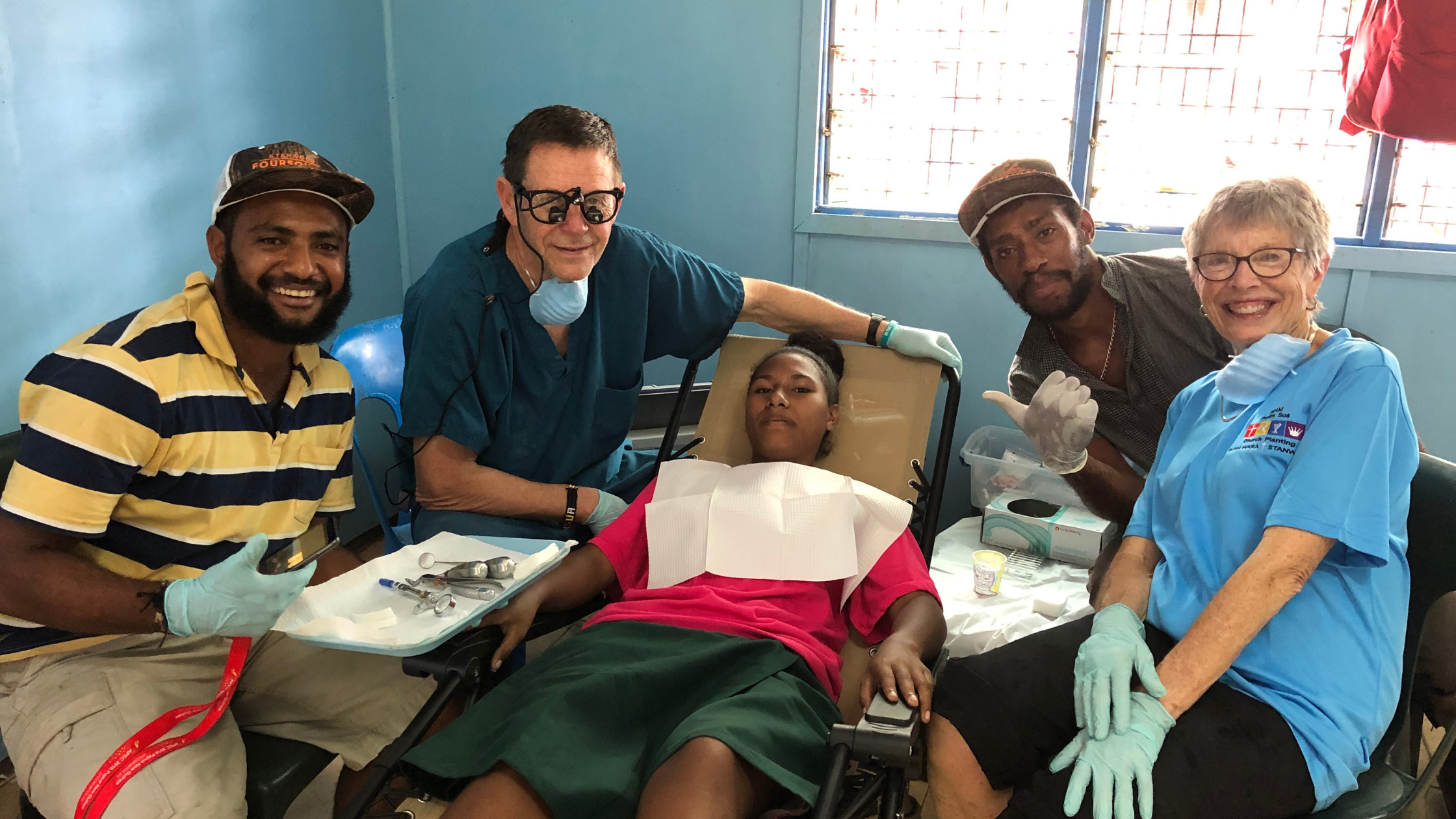
Cheerful and willing helpers in Papua New Guinea.
Where it All Began
Dr. Thompson began his dental career at the University of Washington School of Dentistry, after becoming disillusioned with his initial plan to pursue pharmacy as a profession.
It was the Vietnam War era and he jokes that he was accepted into the School of Dentistry because he came to the interview with a crew cut, in contrast to the longer hairstyles of the day.
Whatever factored into his acceptance, during his dental school years at UW, he enlisted in a program to become an Army dentist upon graduation. That began a 22+ year military career that took him to various assignments, including at Fort Leonard Wood in Missouri, Fort Ord in California, and as commander of a small medical detachment in Europe. His final post was at Fort Lewis, which was just fine with the Thompsons, who had both grown up in and around Arlington and had aging parents still in the area.
Upon his discharge from military service, Thompson sent applications and resumes to dental clinics throughout Western Washington. The only one that responded was a small clinic on Camano Island. He was hired as an associate and soon was offered the opportunity to become a partner. Not long after that, the other partners approached him about buying the entire practice, which he did.
While still a relatively new partner, Thompson approached the other practice owners with the idea to begin offering one day of free care each year and they readily agreed.
“We called it Doctors With a Heart, and it was the free day,” he said. “It was a unique experience in that I asked the staff to volunteer and, without exception, they all signed on. And they looked forward to it every year as a unique time to treat as many people as we could and care for those who otherwise wouldn’t have services available. It was a team-building thing, really, a fun day, and we probably saw 50 or 60 patients that day. It was a lot of work, but I look back on that as something I really enjoyed being part of and helping others be a part of.”
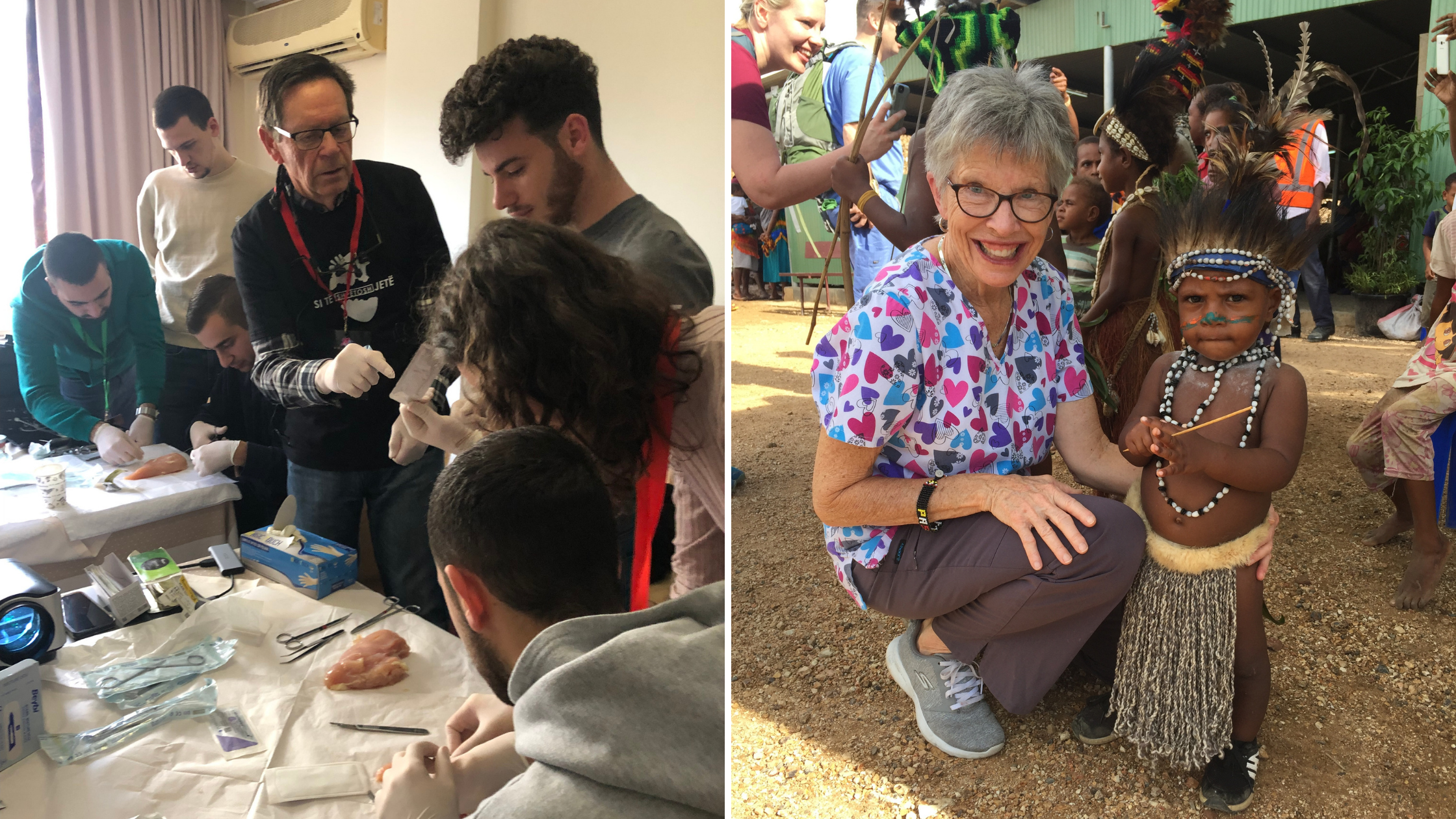
Left: Suturing class at Albanian dental conference. Right: Greeters on arrival to Papua New Guinea.
Giving Back, at Home...
In addition to the free day at his own clinic, Thompson soon became involved with other charitable initiatives in Northwest Washington. He supported community clinic events such as North Cascade Cares in Skagit County, but his most prominent and ongoing commitment has been with Safe Harbor Free Clinic in Stanwood.
Safe Harbor was founded in 2008 and began seeing patients in 2009. The medical portion of the clinic operates three nights per week, while dental care was offered once monthly. The COVID pandemic knocked the dental program for a loop, disrupting its connections with the University of Washington and Medical Teams International, their sources for mobile dental vans and volunteer dentists. Still, Thompson estimates that the program served some 20,000 patients, primarily from Snohomish, Island, and Skagit Counties, between 2009 and 2020, and he’s looking forward to a day when it can begin caring for dental patients again.
“We’re still struggling to bring the dental program back up,” Thompson said. “But Safe Harbor still does a lot of good here; it’s a wonderful organization that has touched a lot of lives.”
While Safe Harbor’s current lack of dental program means Thompson isn’t seeing patients in the clinic, he remains an active volunteer with the organization. He has been a board member since 2013 and previously served as the organization’s president. One person who appreciates all of the roles that Thompson has played with Safe Harbor is the organization’s executive director, Sandy Solis.
“He is a deep encourager to me personally and frequently checks in to see how he can help to support our clinic efforts,” she said. “Most recently, he has worked with us to find ways our community can support access to dental care for our patient population, many of whom do not have affordable access to care. He is thoughtful, kind, compassionate and has deep wisdom, all of which make him a highly valued part of Safe Harbor Free Clinic.”
...And Away from Home
With Randy having begun donating his time and dental skills, and Jamie having dipped a toe in an overseas mission experience, the couple began talking about the possibility of participating in a dental mission trip together. That’s when they received a mailing from the Christian Medical and Dental Association looking for volunteers to travel to Zambia in partnership with Prison Fellowship International.
“We took that as a personal invitation to go to Zambia,” Randy recalled. “It was a general mailing to the membership, of course, but for us it was a personal invitation.”
After securing the support of Thompson’s then-partners at Camano Island Clinic, the couple committed without knowing what to expect. It turns out that caring for patients in a Zambian prison was “one of the most challenging” experiences of their volunteer careers. The prison buildings were relics from British colonial times, designed to house about 20 people but crammed with 70 inmates and bathed in disinfectant so strong it made work indoors impossible.
“We were in a women’s prison. We were in a maximum security prison. Going into those prisons and seeing the conditions, the human condition, and the way they were treated, where they lived … it’s hard to describe, but it was one of the hardest experiences of my life. Every mission trip has been up from that,” he said.
Regardless of the setting, both Thompsons emphasize the importance of the personal connections their mission work has helped them make with patients, other volunteers, and their missionary contacts.
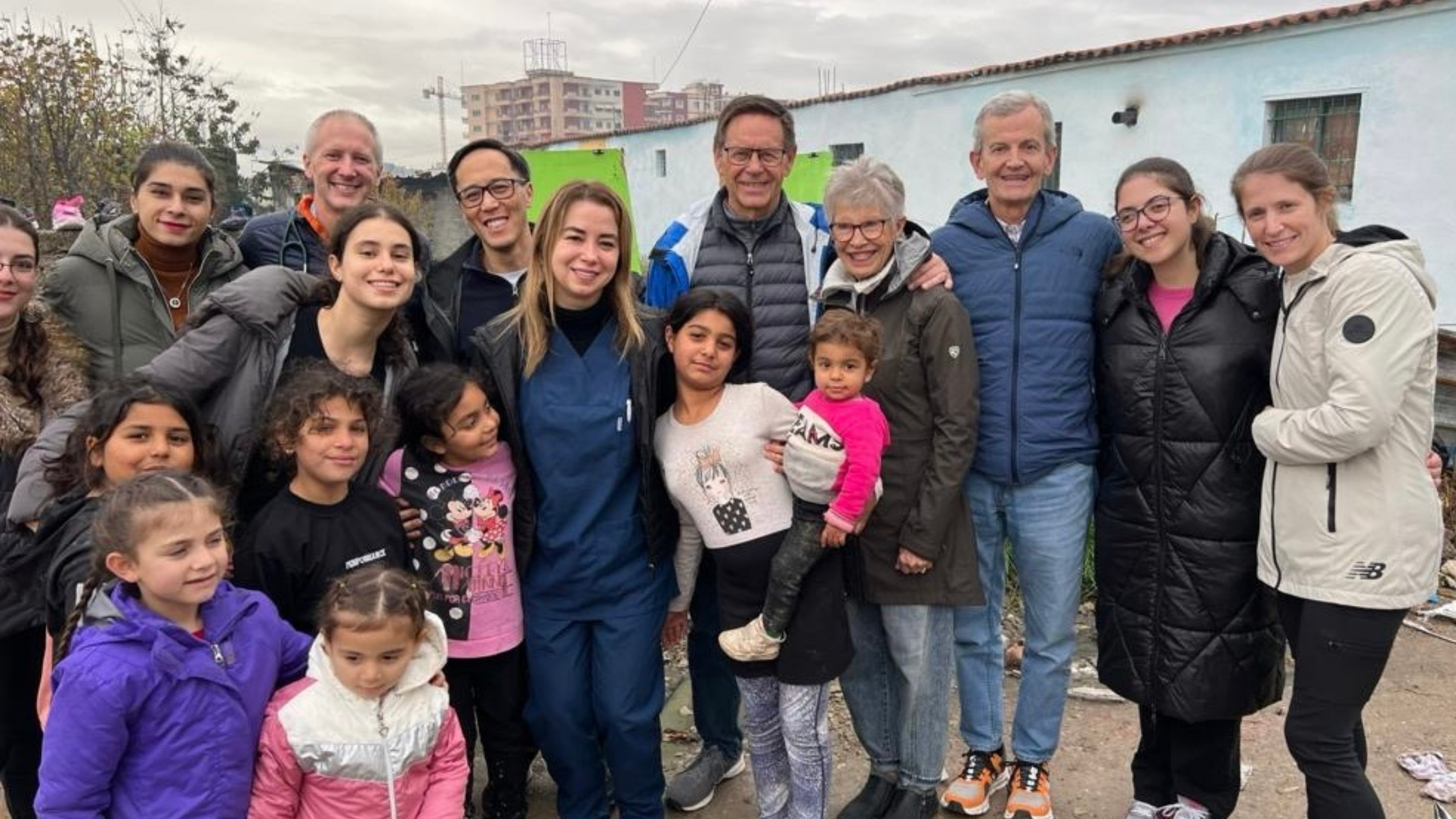
Medical/dental team serving a Roma camp in Albania.
It's All About the People
“You can put yourself in the shoes of the people where you’re going,” Jamie said. “Learn from them, let the people that are around you inspire you and give you roles and models for living that you just never imagined they could.”
Randy agreed. “It’s all about the people we encounter, getting to know people in different cultures, just getting to know them as people. Not only is it fun, but it’s a character-building experience, and the real challenge becomes re-entering your life at home and not forgetting how the mission trip left its mark on your life. We have met wonderful people throughout all those adventures and journeys, and many that we communicate with regularly, and have been able to encourage and support over the years.”
Thompson can give you story after story of people he has met along the way. There was Prospero, a young man with developmental disabilities, in Tanzania. Thompson drew on his experience treating a female patient with similar disabilities in his Camano Island Clinic to help gain Prospero’s trust and deliver the care he needed.
He recalled a female patient in the Dominican Republic who needed two badly broken lower bicuspids removed. Operating without the benefit of x-rays and encountering an unusual root structure, Thompson worked for more than an hour completing the procedure. When he became so worn out that he need to take a quick break, she said softly, “I’m praying for you.”
Then there’s the Albanian dental student the Thompsons met on their first trip to that country. She recently invited them to her wedding.
Perhaps the most memorable was the Haitian dentist who came to observe Thompson and his team in action. After several days, Thompson invited him to work; shortly after that, the local dentist invited Thompson to visit his clinic. When Thompson arrived, he saw a decrepit dental chair and virtually no dental equipment. When he asked what was used to treat patients, the Haitian pulled out a Black & Decker Dremel tool!
Thompson decided on the spot that he couldn’t allow patients to continue being treated with that hardware, and arranged to give the dentist all of the portable equipment he’d brought on the trip. Over the years, the two have stayed in touch and Thompson has continued to help out whenever any of the equipment needed repair or replacement.
Sharon Schaeffer, a hygienist who has accompanied the Thompsons on missions to Ecuador, Haiti, and the Dominican Republic over the years, recalled one tactic that kept the focus squarely on the patients, regardless of their surroundings.
“After each day, we would gather together as a team and share stories of patients who touched our hearts in very special ways. We called them ‘The One,’” she said. “Dr. Thompson’s faith drives him to give generously of his time, talents, and resources. I’ve been in awe of his dedication to give and give and give.”
The Standard of Care
One reason why Thompson was in a position to help the Haitian dentist retire his Black & Decker was that he had changed his own approach to mission work. Early on, the expectation was that a visiting dentist would perform almost nothing but extractions on local patients. That approach made sense on some level: it relieved a patient’s pain and eliminated the risk of an abscess that could eventually become life-threatening. But it was on his first trip to Chile that he changed his thinking.
“We were on a boat, sent out by a local church, to serve patients on remote islands eight hours away” he recalled. “More than half the people I saw wanted me to just remove their teeth, but I could tell these were teeth that just needed to be filled. I didn’t have all the instruments and supplies that I needed to put a filling in. But I didn’t feel good about taking their teeth out just because I was there.”
So he set about assembling the equipment and instruments needed to do fillings and tackling the logistics of getting all of it to a remote location. On some trips, he has even been able to take some minimal lab equipment to make partials for people who have lost an anterior tooth. He researched and obtained the portable equipment needed, and was blessed with dental suppliers and colleagues who either donated or discounted equipment, instruments, and other supplies.
“I could take you to my attic and show you that I have full dental clinic stored up there,” he said of his success in assembling these resources. That success has also allowed Thompson to deliver care that is as close to the standard of care as possible, given the surroundings.
“I’m not there to extract teeth just because I’m there,” Thompson said. “The teeth that I’ve removed in these settings are teeth I would diagnose for extraction in my office.”
Sharon Schaeffer, the hygienist, confirmed that approach when she said that Thompson “displays his gift in loving others through dentistry, with no constraints as to where the location is. He focuses on every patient and gives them his undivided attention.”
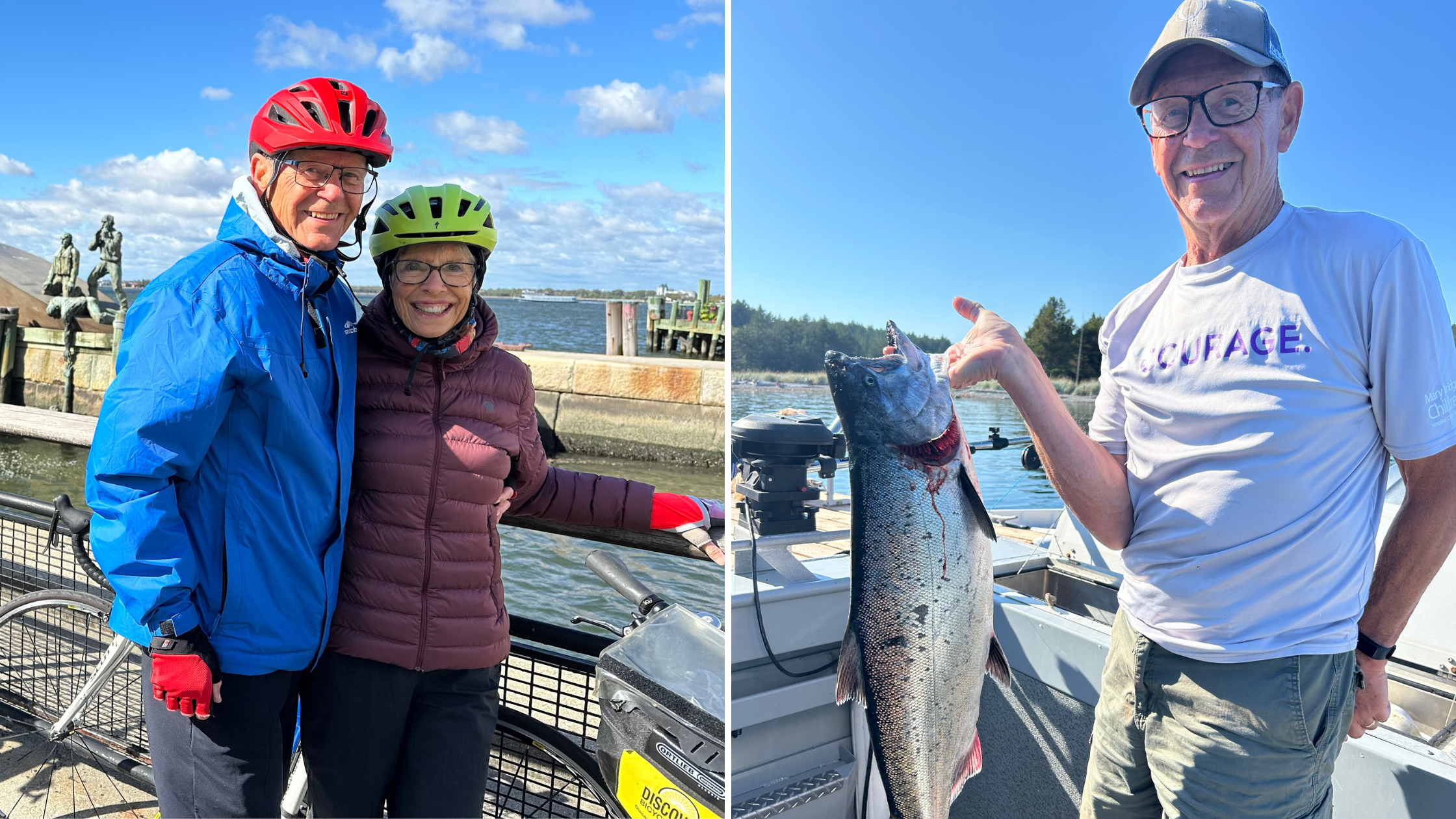
Left: Biking the Hudson River Valley. Right: Summer fun in the San Juans.
An Inspiration to Others
That personal approach has served as an inspiration to others who have joined Thompson along the way.
“He exemplifies humility and compassion in working with and serving those in need,” said Dr. Luke Park, who has worked with the Thompsons in Albania. “Although we were technically colleagues in our roles, I’ve always looked up to him as not only a professional mentor, but also someone I aspire to be like as a consummate volunteer and servant. He and Jamie truly live out what it means to help and serve others.”
Thompson sees encouraging others to volunteer as part of his role.
“I think most dentists probably do this anyway. They have situations in their offices where they see people in need and just do something pro bono. Then if they want to go beyond that, there are lots of groups that are well organized for volunteers. They’re ready. They have the stuff that you need, and you just need to show up and use your skills. Our participation is critical. It’s good for the community and I think you’ll be rewarded in ways you don’t really realize,” he said.
Speaking of her husband’s reward of being named this year’s WSDA Citizen of the Year, Jamie Thompson spoke with justifiable pride.
“I just know that God has blessed him and that he saw that he had a skill that could be used to help people. For me to see him now being honored, it means everything to me.”
Randy Thompson, as is his style, is modest in discussing the award. “To be recognized for something that I think is a normal part of my life and a part of my purpose is quite humbling. I’m honored to represent our profession in this way, but I’m really, really thankful for the many colleagues who have mentored me, who have encouraged me, and who have been able to serve with me in these endeavors.”
This article was originally published in Issue 3, 2026 of the WSDA News.
